
This is a question I get asked a lot: What is the difference between used to do something and be used to doing something? Well I am going to give you some nice, natural examples to hopefully clear that up for you!
Let’s look at the difference between:
- I used to drive an automatic car
- I’m used to driving an automatic car
Used to + infinitive
1) means that you did this in the past but you don’t do it anymore.
In other words, I sold my automatic car and now I drive a manual.
So you can use USED TO + INFINITIVE to talk about past habits or past states.
Here are some real examples of USED TO + INFINITIVE about my life:
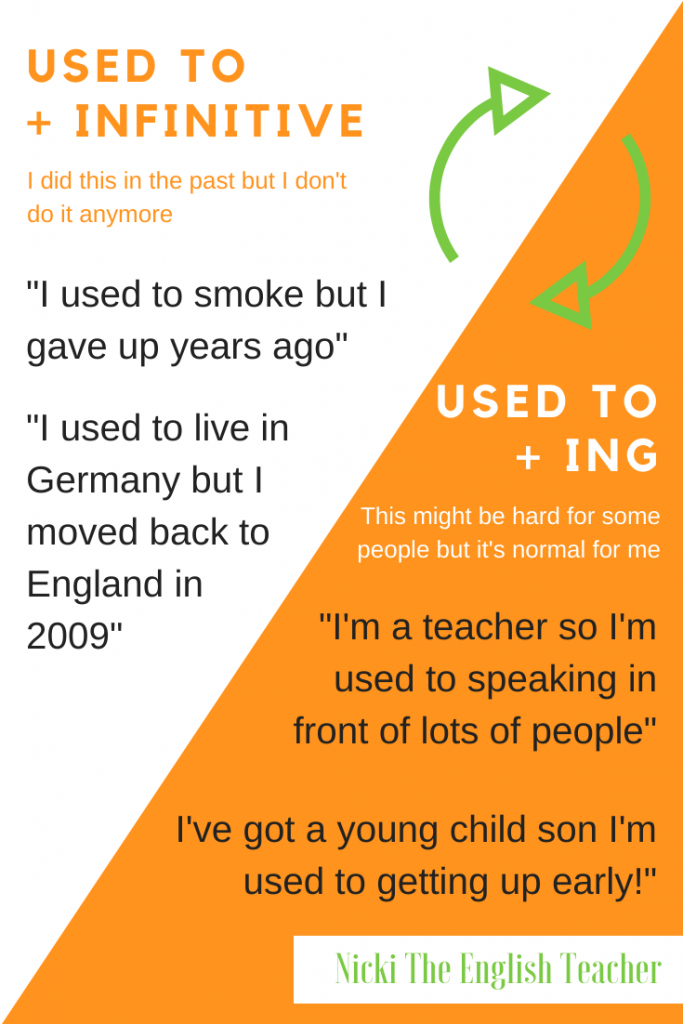
“I used to smoke but I gave up years ago.”
“I used to live in Germany but I moved back to England in 2009.”
You can see that I no longer smoke and I don’t live in Germany anymore. These habits/states are finished.
Be used to + ing
2) means that something is normal/easy/familiar for you, although it might be challenging/uncommon for others.
In other words, some people might find driving an automatic car strange but for me it’s normal because I do it all the time.
In this situation you can use BE + USED TO + ING.
Here are some real examples of BE + USED TO + ING about my life:
“I’m a teacher so I’m used to talking in front of lots of people.”
“I’ve got a young child so I’m used to getting up very early in the morning.”
You can see that talking in front of lots of people or getting up very early might be challenging or uncommon for some people but for me it’s a part of daily life.
Do you want to save that somewhere handy to remember it? Here you go:
Mini Writing Challenge:
Have you got any examples of your own? What did you used to do that you don’t do anymore? Or is there something that you are used to doing in your daily life that other people might find challenging? Leave me a comment below and I’ll check your grammar for you!
Want to improve your grammar?
This grammar (used to and be used to) plus the main English tenses and other useful structures are all covered in detail in my Grammar Genius course – You can find out more here!



10 Responses
I used to visit his home every weekend during my study there.
Being a helper, I am always used to looking after their children.
Reading your examples, it’s clear that you have understood the difference between the structures and their different meanings! Well done Shantikumar, and thanks for trying my writing challenge 🙂
I used to live in Venezuela and now I’m used to living in Chile.
Ah, a lovely sentence which combines both structures perfectly! Thanks Juan 🙂 I’m pleased to hear you’ve adjusted to your new life in Chile!
I used to watch comedy movies .
I am used to watching classic movies
Well done for trying the writing challenge Ajmal! You’re obviously a big movie fan 🙂 I’d say your first sentence is fine, maybe just give it a bit more context ‘I used to watch comedy movies but I don’t really like them anymore’, an ending like that for example.
The structure of the second sentence is good but the meaning doesn’t really work, have another read of the blog post, ‘be used to’ should be something that’s perhaps challenging, or not typical for other people. Feel free to try that one again 🙂
A: I used to teach at university in Thailand.
B: I’m used to teaching at hospital in LAO.
Great examples! The first one is perfect (as you obviously don’t work there anymore) and the second one is good too but could maybe just do with a bit more context to highlight the meaning of ‘be used to’, as it’s not just a daily habit but also something that could be challenging or uncommon. For example ‘I found it tough to change hospitals but now I’m used to teaching at the hospital in Lao’. That would just make the meaning clearer but great work Krueyok, thanks for sharing 🙂
Hi Nicki,
As always your lessons are very helpful!
Having a look at the expressions you described I could manage a few examples:
1) Until I finished University I used to live with my parents and siblings in a small town. When I began the MBA I moved to a big city.
2) A few years ago I became Managing Director of a Hospital and due to my responsibilities I am now very used to speaking in front of lots of people.
Thanks for your useful blog. Have a great week!
Fantastic examples Monica. You have clearly shown the difference between the 2 structures with very natural contexts, great! I’m so pleased this was a useful post for you 🙂